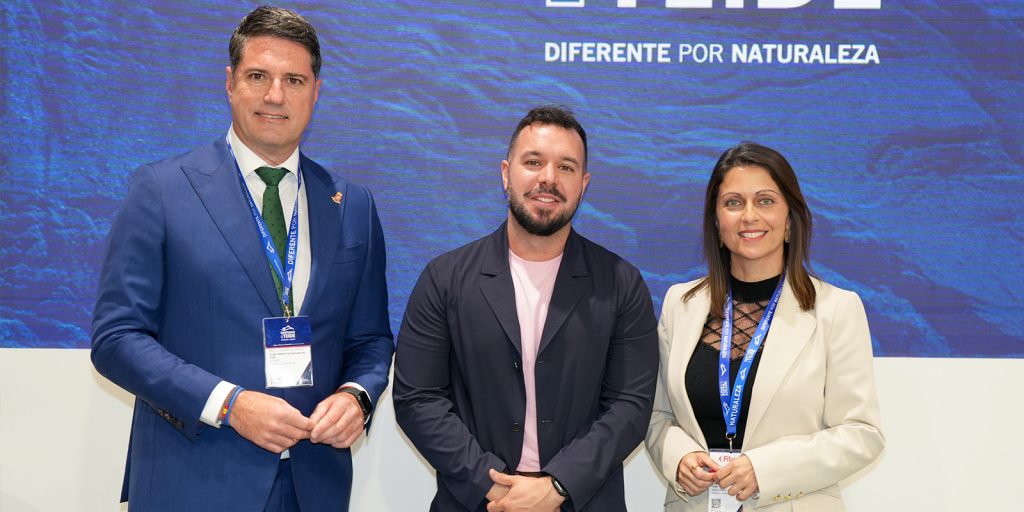
Santiago del Teide took part in a new edition of the International Tourism Fair (FITUR), held in Madrid, one of the leading international events in the tourism sector, where it presented the SDTree campaign, an initiative that reflects a way of understanding the destination through the relationship between people and the environment they inhabit and visit.
Throughout the event, the municipality shared with tourism professionals a proposal that highlights the value of the territory and the importance of understanding it to protect it, reinforcing an approach to the destination that is closely connected to local identity and to a respectful relationship with the landscape.
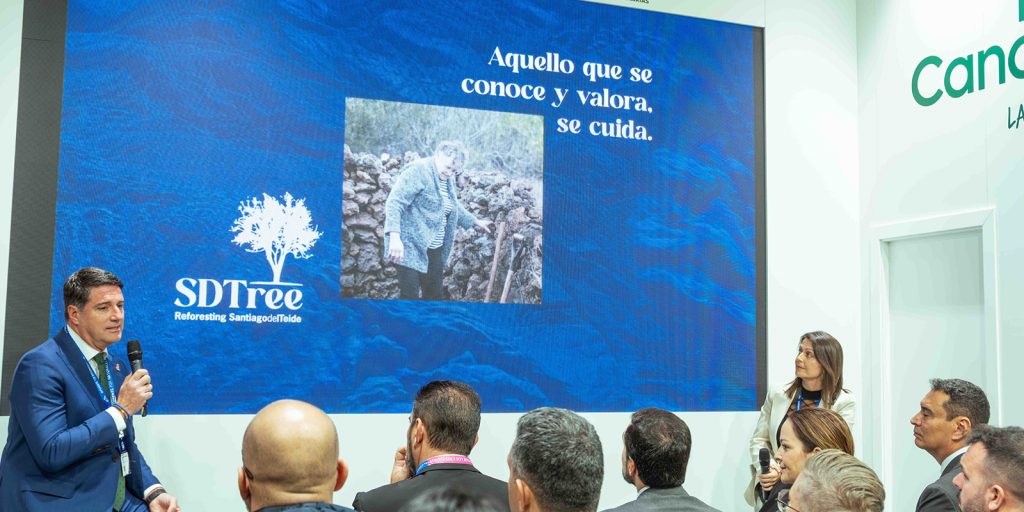
A reforestation initiative linked to the territory
The campaign emerged following an incident that took place last summer in the municipality: a wildfire in the Special Nature Reserve of Chinyero. The fire affected more than 70 hectares and led to the loss of almond trees, fig trees, and other traditional crops.
Within this context, SDTree was developed as a reforestation initiative carried out in the surroundings of the Reserve, involving residents, municipal staff, local businesses, and visitors staying in the municipality.
The initiative enabled those visiting Santiago del Teide to take part in an activity directly connected to the territory, sharing knowledge about the landscape and understanding the value it holds for those who have worked and cared for it over generations.

This action is also framed within Santiago del Teide’s commitment to the 2030 Agenda. Through SDTree, the municipality contributed directly to five Sustainable Development Goals already certified and is progressing towards the certification of Goal No. 17, related to partnerships.
If achieved, Santiago del Teide would obtain certification in 15 of the 17 SDGs, positioning it as the only municipality in Europe with this level of recognition.
As explained by the Mayor of Santiago del Teide, Emilio Navarro, initiatives of this kind allow visitors not only to enjoy the environment, but also to engage with the territory through experiences connected to its identity and to the way it has historically been lived in and cared for.
For her part, the Councillor for Tourism, Luz Goretti Gorrín, noted that SDTree forms part of an ongoing line of work in which the municipality promotes concrete actions linked to the territory, demonstrating that such initiatives can also generate a positive impact in terms of environmental care and territorial awareness.

Discovering the territory through those who inhabit it
One of the most meaningful aspects of the initiative was the participation of several local women who have been connected to the territory since childhood. They took part in the planting and shared with visitors how this landscape has been present in their lives.
This close exchange conveyed how the environment has been lived in and worked over generations, and what it represents for those who know and care for it.
The initiative also incorporated the use of compost produced within the municipality, linked to a circular economy project in which more than 40 families already participate. This was a coherent gesture aligned with the campaign’s approach, extending the relationship with the environment to the way the activity itself was carried out on the ground.

A destination that is understood and valued, is cared for
SDTree forms part of a broader approach in which Santiago del Teide links environmental care to concrete actions and to the involvement of both residents and visitors, highlighting a direct and shared relationship with the space that defines the municipality.
Through this campaign, Santiago del Teide invites visitors to discover the municipality from an attentive and close perspective, understanding that to know a place means to understand it, respect it, and become, even if only briefly, part of the way in which this environment is lived in and cared for.